
The Quick Sprout
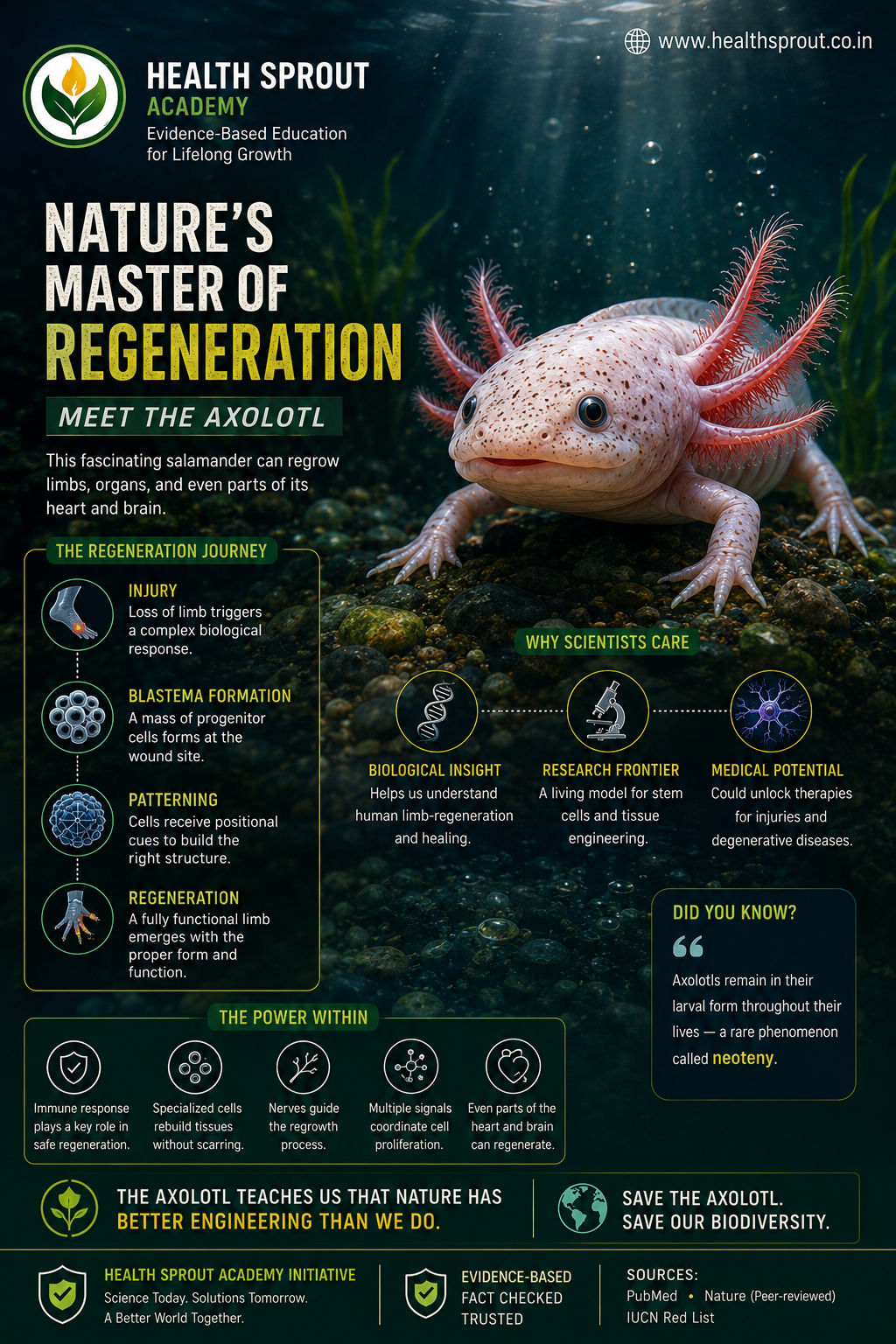
- An axolotl can regenerate organised structures such as limbs through coordinated wound healing , cell behaviour, positional information and tissue patterning .
- Regeneration is not unlimited: the animal does not simply regrow every body part perfectly under every condition.
- Research on axolotls helps scientists study how living tissues rebuild complex structures after injury.
How to use this: Read this box first for the core message, then continue into the full evidence-based explanation below.
The Animal That Can Rebuild Itself
Imagine losing a limb and growing it back. For an axolotl, that is a remarkable part of its biology.
The axolotl ( Ambystoma mexicanum ) is a salamander and one of the most intensively studied vertebrate models of regeneration. Its importance is not simply that it “grows a limb back”; researchers use it to understand how wound healing, cell behaviour, positional information and tissue patterning can work together to reconstruct an organised structure.
What Exactly Is an Axolotl?
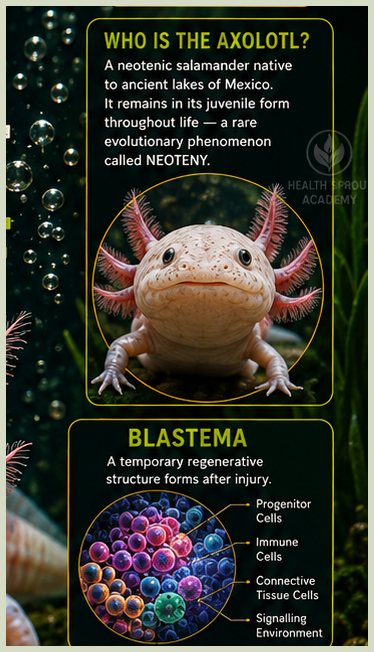
The axolotl is a Mexican salamander whose scientific name is Ambystoma mexicanum . It is famous for retaining aquatic, juvenile-like characteristics into sexual maturity and for its extraordinary regenerative capacity.
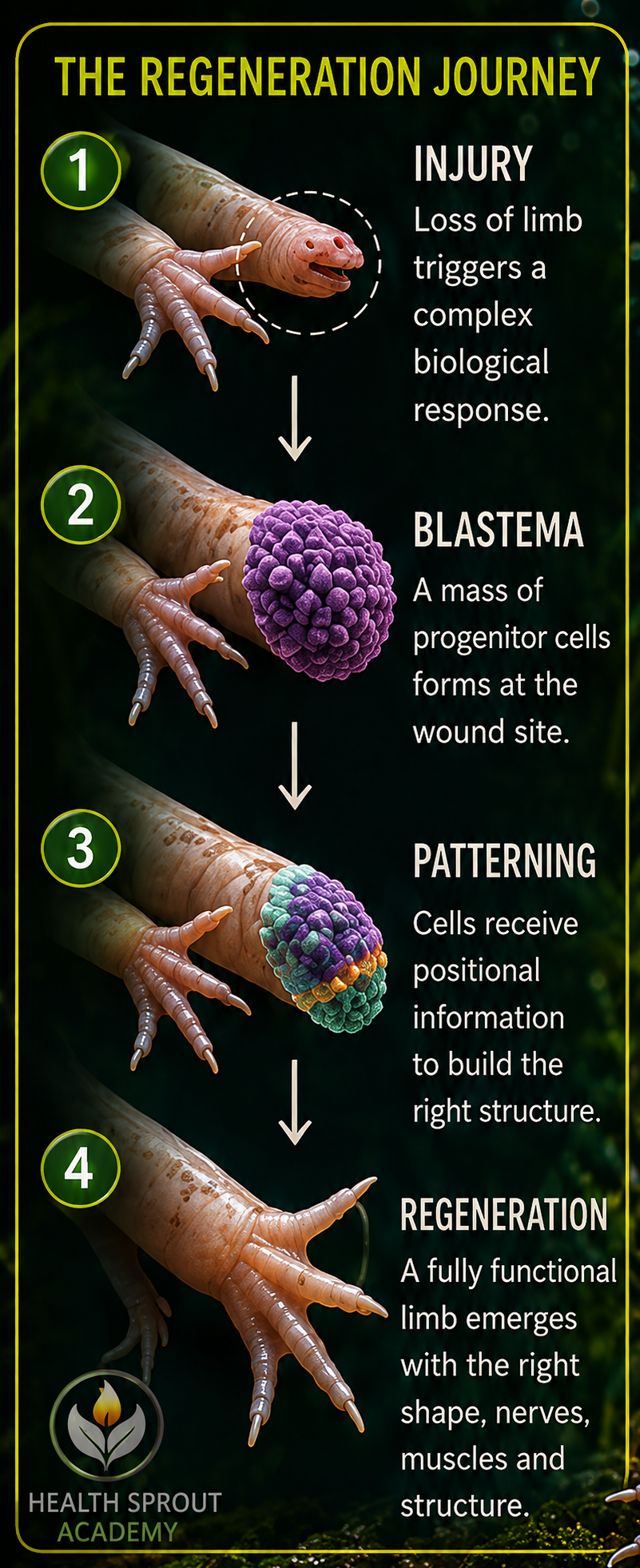
How Can It Rebuild a Limb?
After injury, a specialised wound epidermis forms and a regeneration-competent structure called a blastema develops beneath it. Cells proliferate and communicate with surrounding tissues while interpreting positional information before contributing to the missing structures.
The Blastema: The Temporary Structure Behind Regeneration
A blastema is a temporary regenerative structure that forms after injury. It is not simply a bag of identical stem cells. Research describes multiple cell populations that contribute to regeneration in coordinated ways.
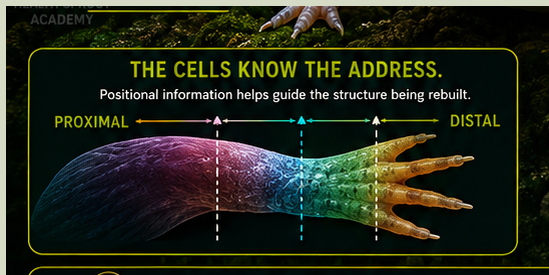
Cells Remember Where They Came From
One of the most interesting ideas in regeneration biology is positional information . Cells retain information related to where they came from within the limb. During regeneration, cells with different positional identities communicate and help organise the missing structures.
Regeneration is not random regrowth. It is organised biological reconstruction.
Regeneration Is More Than “Growing Back”
The regenerated limb must recreate an organised structure. Bone, cartilage, muscle, connective tissue, nerves, blood vessels and skin must be positioned appropriately. The key question is therefore not simply “How does it grow?” but “How do cells know what is missing and organise the replacement correctly?”
Can Axolotls Regenerate Anything? Are They Immortal?
No. Regenerative capacity varies by tissue, developmental stage, injury and experimental conditions. Limb regeneration is the best-known example. Claims that the axolotl can “regenerate literally anything” or is “immortal” are too absolute.
Can Humans Regenerate a Lost Limb Like an Axolotl?
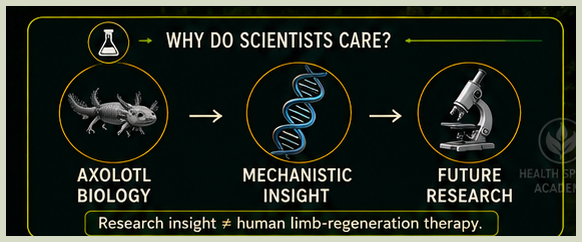
Not currently. Adult humans cannot naturally regenerate a complete lost limb. Axolotl research is helping scientists understand wound healing, cellular states, positional information and developmental signalling, but an axolotl-based therapy that allows humans to regrow a complete limb is not an established clinical treatment .
Why Scientists Study Axolotls
- To understand how complex tissues regenerate after injury.
- To study blastema formation and regenerative cell behaviour.
- To investigate positional information and cellular communication.
- To understand how wound healing can become a coordinated developmental programme.
- To identify biological principles that may eventually inform regenerative medicine.
A Conservation Story, Too
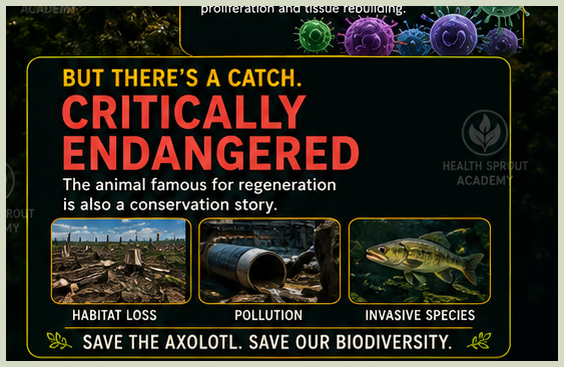
The axolotl’s scientific fame should not hide its conservation problem. Wild axolotls are associated with the remaining wetland and canal habitat of Xochimilco in Mexico City. The species is classified as Critically Endangered on the IUCN Red List, and its wild populations face environmental pressures.
Frequently Asked Questions
Is a blastema just a collection of stem cells?
No. The blastema contains multiple cell populations and is part of a broader regenerative environment involving nerves, wound epidermis, positional signals and tissue interactions.
Can humans currently regrow a lost limb using axolotl research?
No. That remains a research goal rather than an established clinical capability.
Why This Matters
Regeneration is not simply about regrowing a missing body part. It depends on coordinated wound responses, cell behaviour, positional information and tissue patterning. The axolotl provides a powerful model for understanding how damaged tissues can rebuild structure rather than only form scar tissue.
Myth Bust
Myth: Regeneration means the animal can simply “replace” any lost tissue.
Fact: Regeneration is a highly organised biological process. Successful repair depends on signals, cell populations and spatial instructions that guide the new tissue into the correct structure.
Practical Application
When studying regeneration, separate three ideas: wound response, rebuilding of tissue and restoration of anatomical pattern. Keeping these stages distinct makes it easier to interpret experiments and avoid the misconception that regeneration is simply faster healing.
Quick Takeaways
- Regeneration is an organised biological programme, not uncontrolled cell growth.
- The blastema is a key regenerative structure, but regeneration also depends on signals from surrounding tissues.
- Wound healing, positional information and tissue patterning work together during regeneration.
References & Further Reading
- Nature Reviews Molecular Cell Biology — axolotl regeneration research.
- Nature — research on developmental information during regeneration.
- npj Regenerative Medicine — axolotl regeneration research.
- eLife — positional communication and limb patterning.
- IUCN Red List of Threatened Species — Ambystoma mexicanum .
- Health Sprout Academy — BIOWILD #01 fact-checked evidence dossier, reviewed 13 August 2026.