
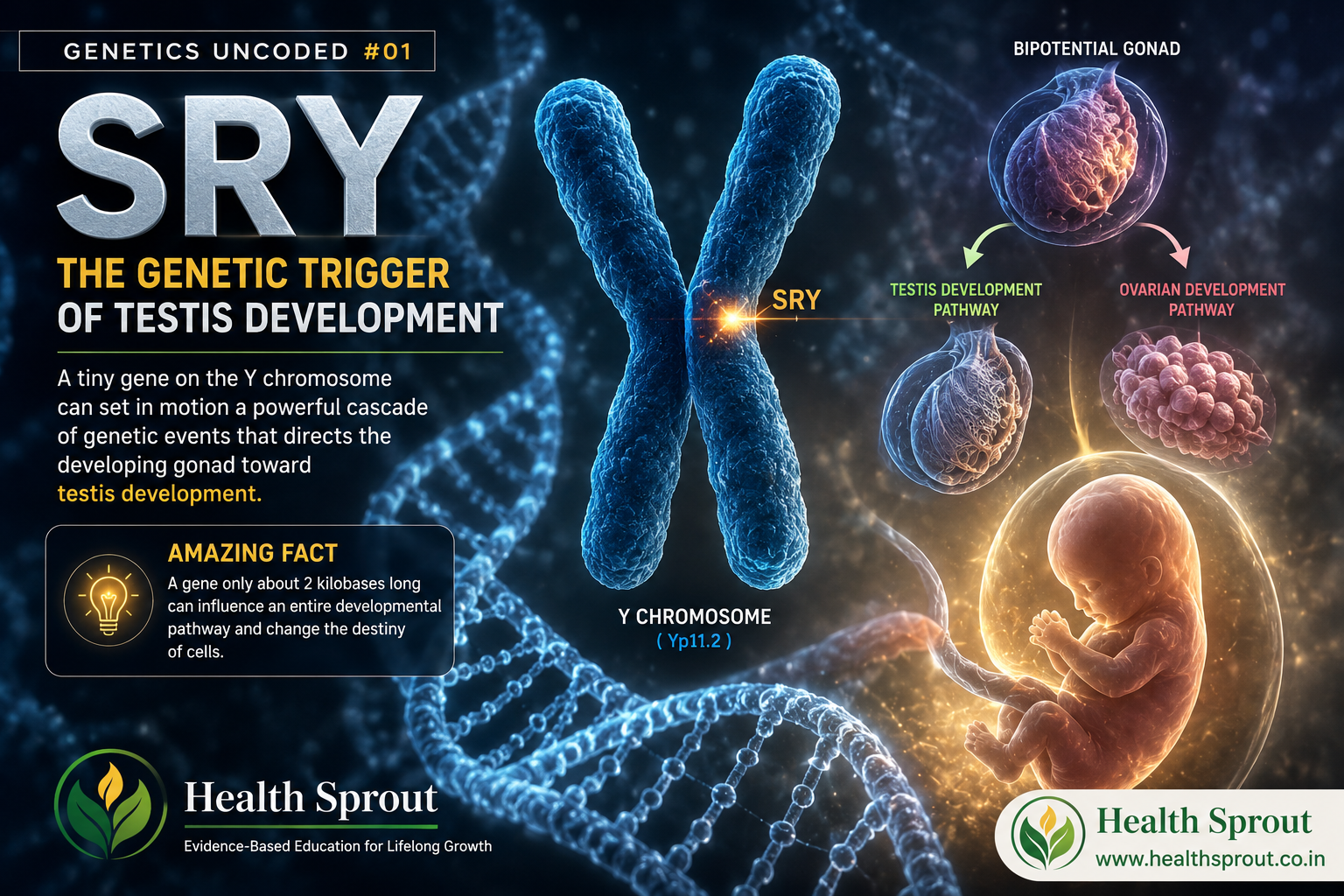
Listen to the Podcast
Prefer listening? Explore SRY, the SOX9 pathway, the developmental gene network and why testis development is more than a one-gene switch in the companion episode.
How Does SRY Start the Testis Pathway?
A focused companion discussion on SRY, SOX9, the bipotential gonad, developmental signalling and the wider genetic network involved in testis development.
Play here on the article page, or open the full episode on YouTube.
The Quick Sprout
- SRY is a key developmental trigger, but it does not build a testis by itself.
- SRY encodes a DNA-binding transcription factor that helps shift the developing bipotential gonad toward the testis pathway, especially through the SRY → SOX9 axis.
- Sex development involves a wider regulatory gene network, so the biology is more nuanced than a simple one-gene switch.
How to use this: Read this box first for the core message, then continue into the full evidence-based explanation below.
Before SRY: the gonad starts with a choice
Early in development, the gonad is bipotential: its supporting-cell lineage can enter either the testis-development or ovarian pathway. SRY does not act as an isolated switch that creates every feature of sex development. Instead, when expressed in the appropriate developmental context, it acts as a key trigger that helps shift the regulatory balance toward the testis pathway, with the SRY → SOX9 relationship forming a central part of that cascade.
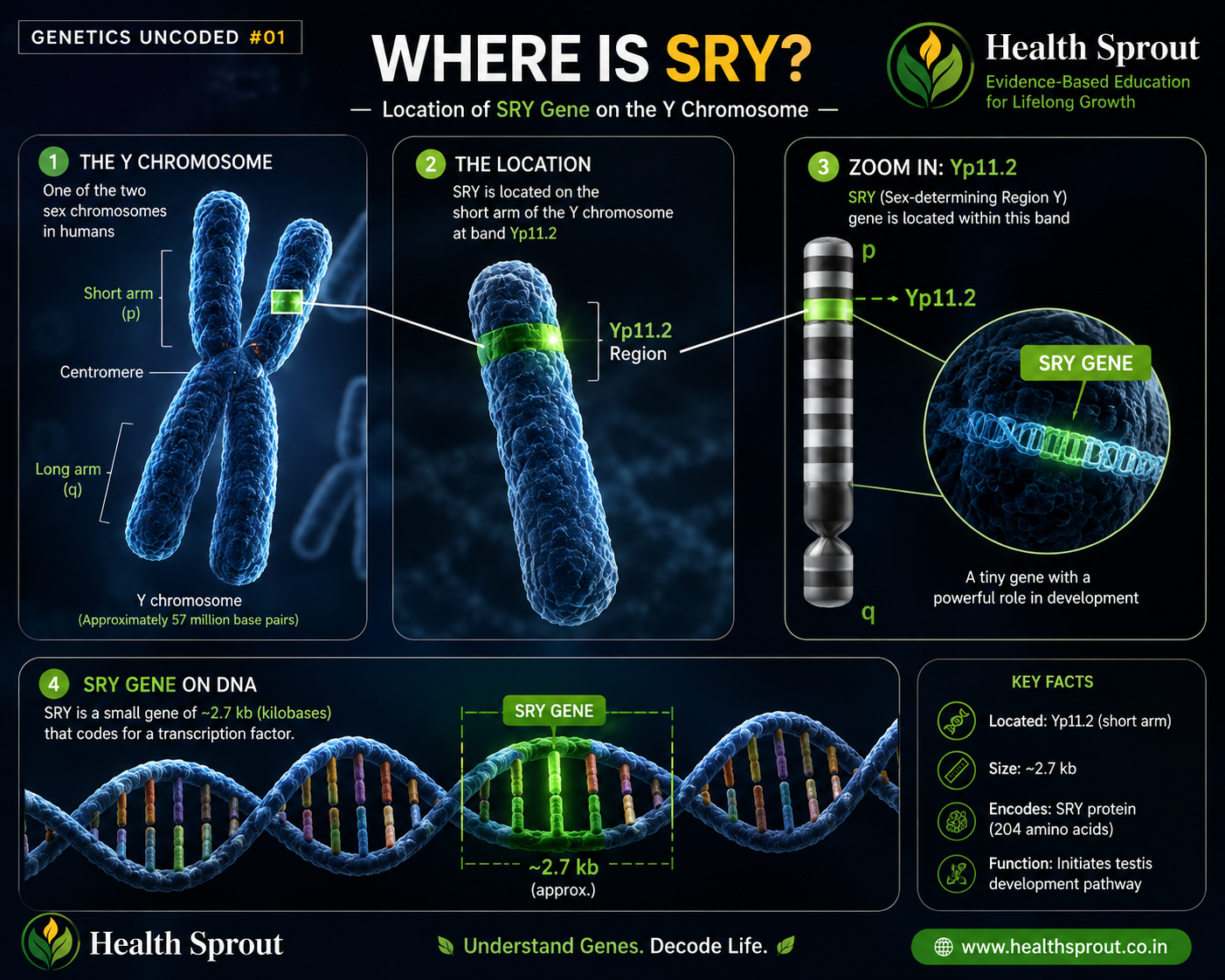
From the Y chromosome to a specific genomic region
SRY stands for sex-determining region Y. It is a protein-coding gene on the Y chromosome. The gene encodes the SRY transcription factor, which acts as a DNA-binding regulator during early gonadal development.
What this visual shows
This visual first identifies the Y chromosome as the location of SRY, then zooms in on the specific genomic region where the SRY gene is found. The diagram connects that DNA-level location to the SRY protein produced from the gene, helping you follow the sequence from chromosome → gene → protein before the developmental pathway is discussed.
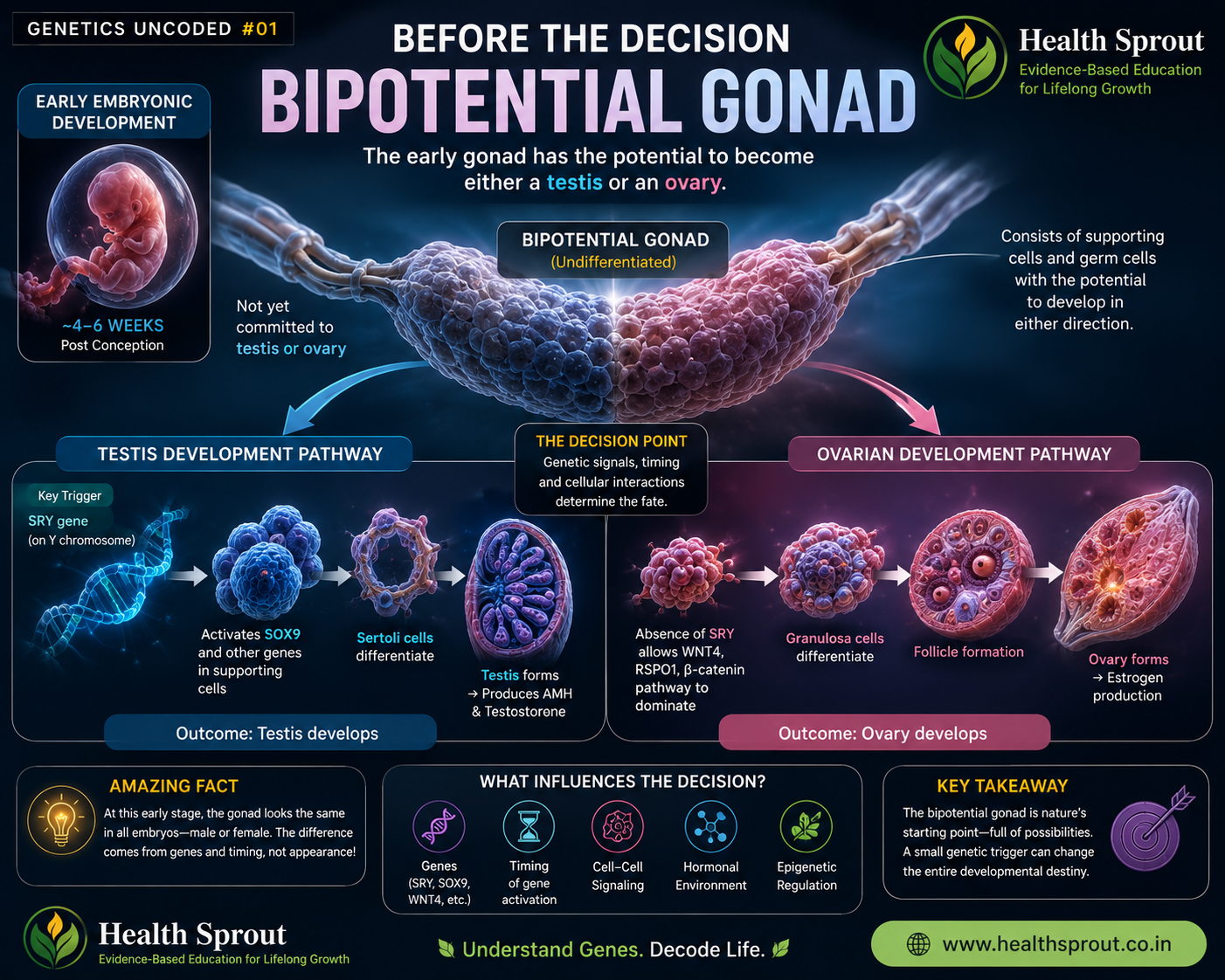
The bipotential gonad is the starting point
Early in development, the embryonic gonad is bipotential: it has the capacity to follow different developmental pathways. The key idea is coordinated gene regulation, not a single switch acting alone.
What this visual shows
This visual shows the developmental starting point: the early gonad is still bipotential, meaning its supporting-cell lineage has not yet committed to the testis-development or ovarian pathway. The diagram is meant to show the branching context in which SRY becomes important, rather than suggesting that SRY creates the entire gonad or acts as a standalone switch.
Gene → protein → DNA binding → regulation
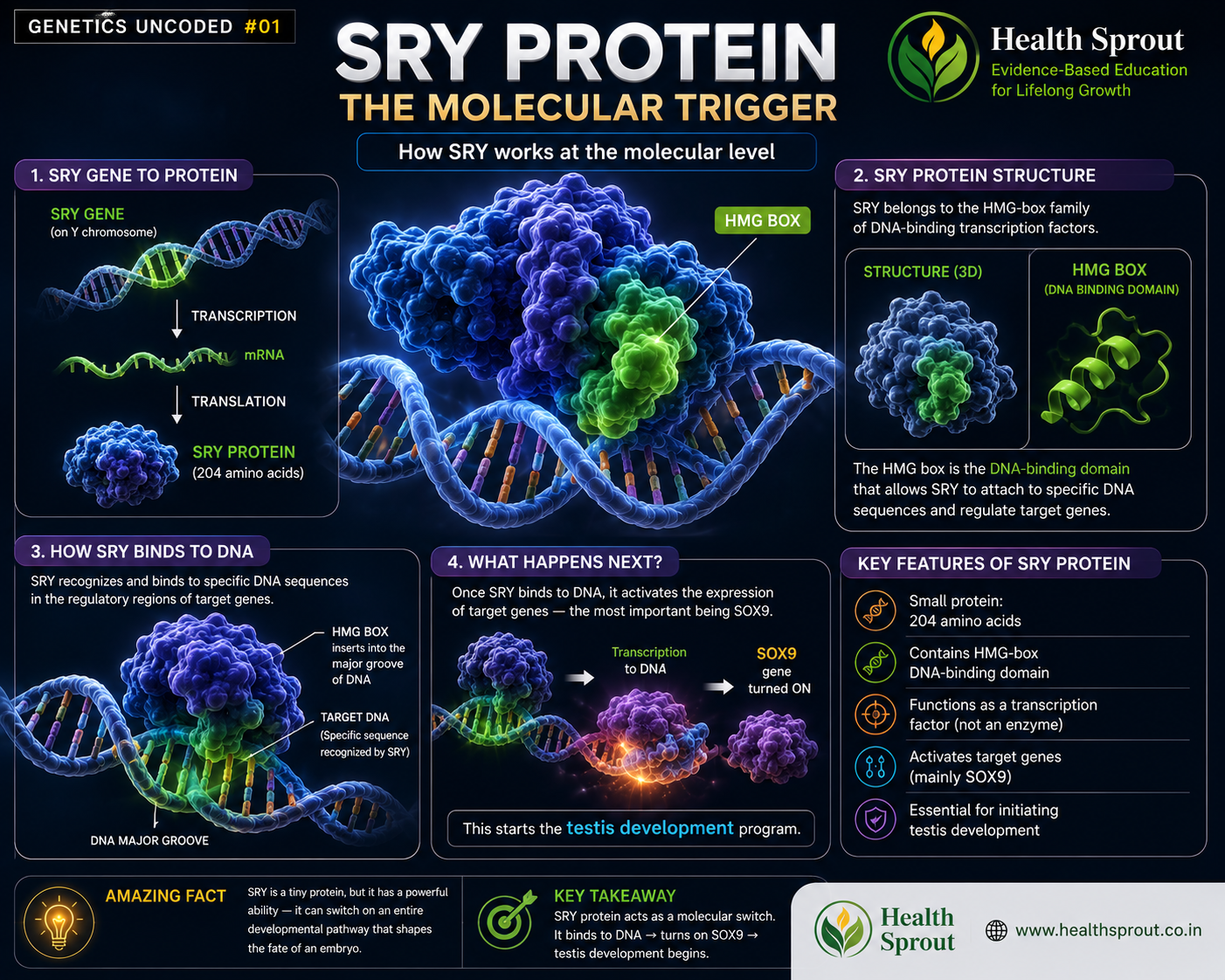
SRY encodes a DNA-binding transcription factor. Its HMG-box domain is central to DNA interaction and can alter DNA structure, allowing regulatory interactions that help control downstream gene expression.
What this visual shows
This visual follows the molecular journey from the SRY gene to the SRY protein. The HMG-box is highlighted because it is the DNA-binding domain that helps SRY interact with DNA and influence regulatory processes. Reading the visual from gene → protein → HMG-box → DNA interaction makes it easier to understand why SRY is described as a transcription factor rather than as a structural component of the testis.
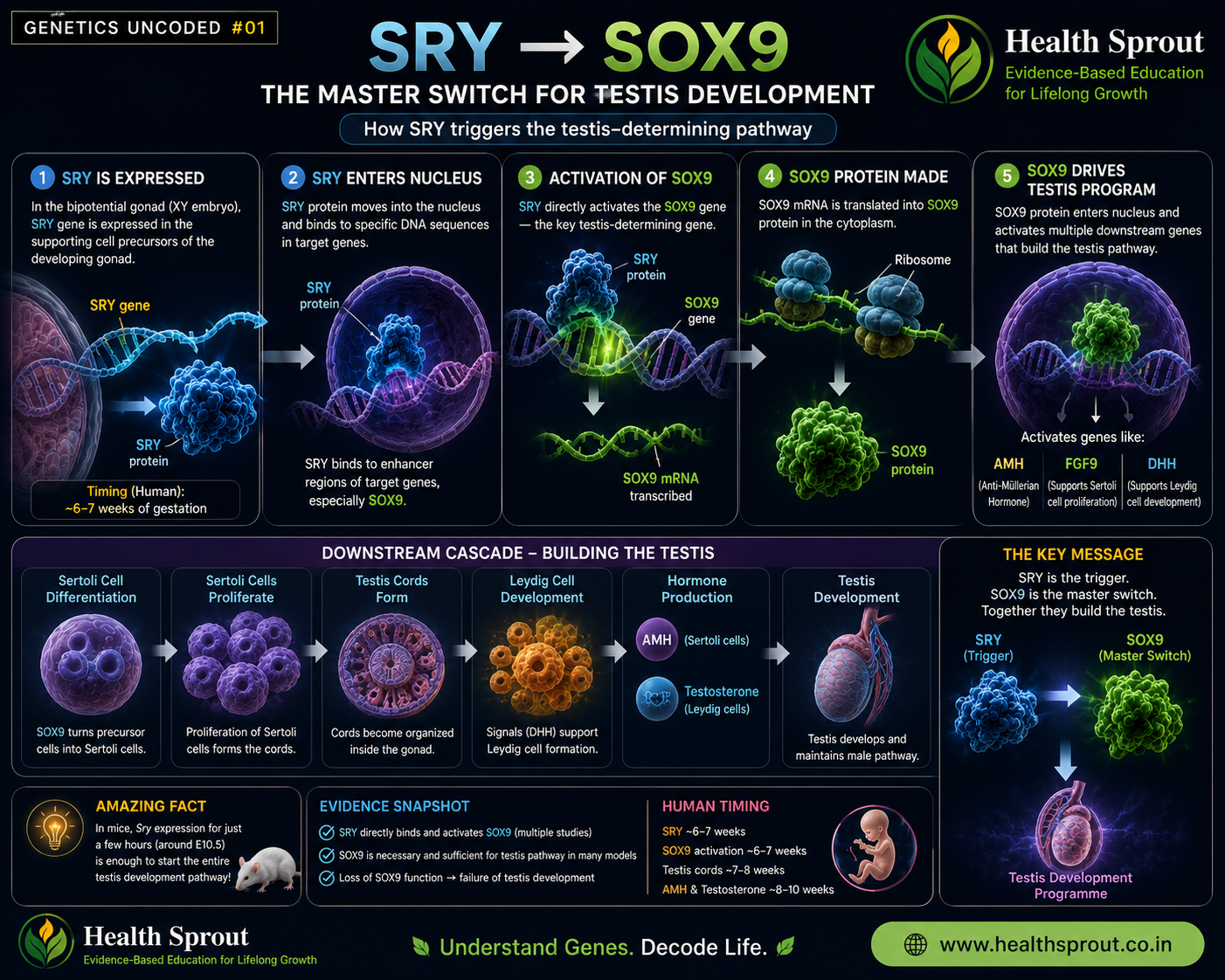
SRY → SOX9 is the central simplified cascade
SRY acts in supporting cells of the developing gonad and helps initiate increased SOX9 activity. SOX9 becomes a major regulator of the testis-development programme, including Sertoli-cell differentiation.
What this visual shows
This visual shows the central simplified molecular cascade of the article. SRY acts as an early regulatory trigger in supporting cells of the developing gonad and helps increase SOX9 activity. SOX9 then becomes a major regulator of the testis-development programme, including Sertoli-cell differentiation. Follow the arrows from SRY → SOX9 → Sertoli-cell differentiation → the broader testis-development programme.
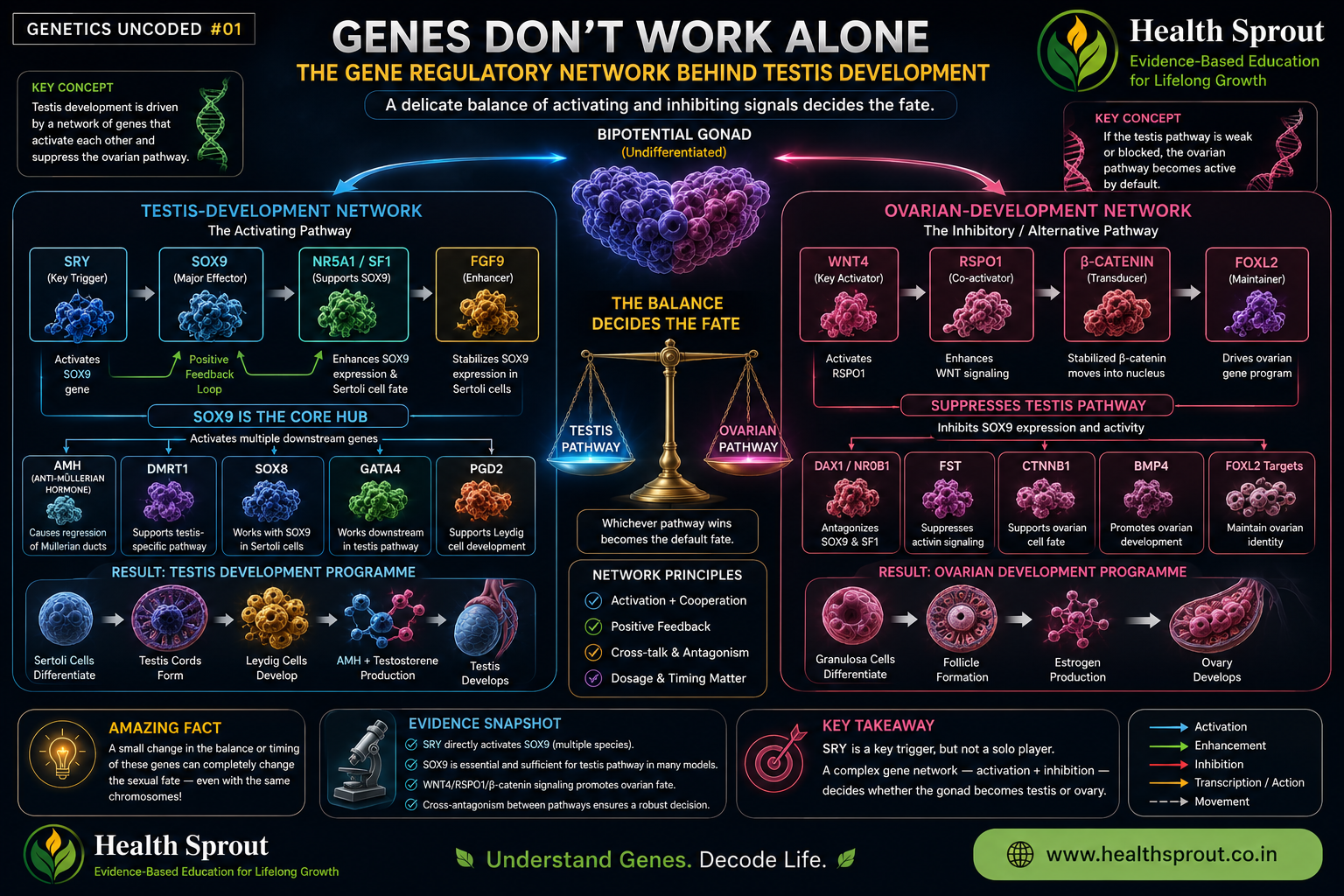
SRY is a trigger inside a regulatory network
NR5A1/SF1, SOX9 and other regulators participate in testis development. FGF9 and related signalling reinforce the testis programme, while WNT4, RSPO1 and β-catenin contribute to the alternative developmental programme. The interactions are not all direct.
What this visual shows
This visual expands the pathway beyond SRY and shows why one-gene explanations are too simple. SRY interacts with a broader regulatory environment that includes transcription factors and signalling pathways such as SOX9, NR5A1/SF1, FGF9 and the WNT4/RSPO1/β-catenin system. The connections represent a coordinated developmental network, not a single linear chain in which every gene acts directly on every other gene.
Human evidence and mouse evidence must stay separate
Human embryonic studies and experimental animal studies provide complementary evidence, but their timelines should not be mixed. Mouse embryonic-day timing must never be presented as human timing.
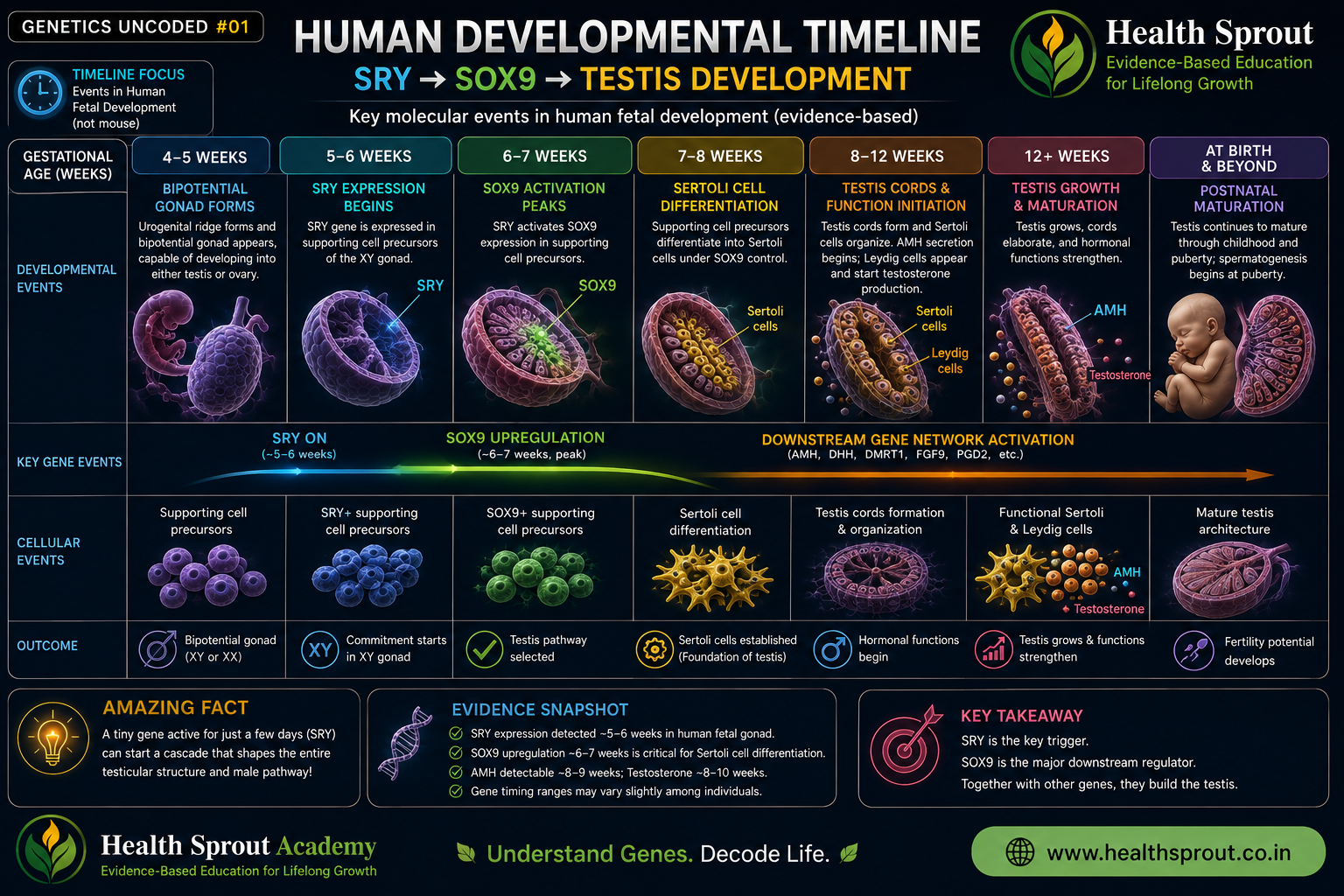
Human evidence
The dossier describes SRY expression during early gonadal differentiation, with SOX9 appearing shortly afterward. Exact timing depends on developmental-age convention, tissue and assay.
Experimental mouse evidence
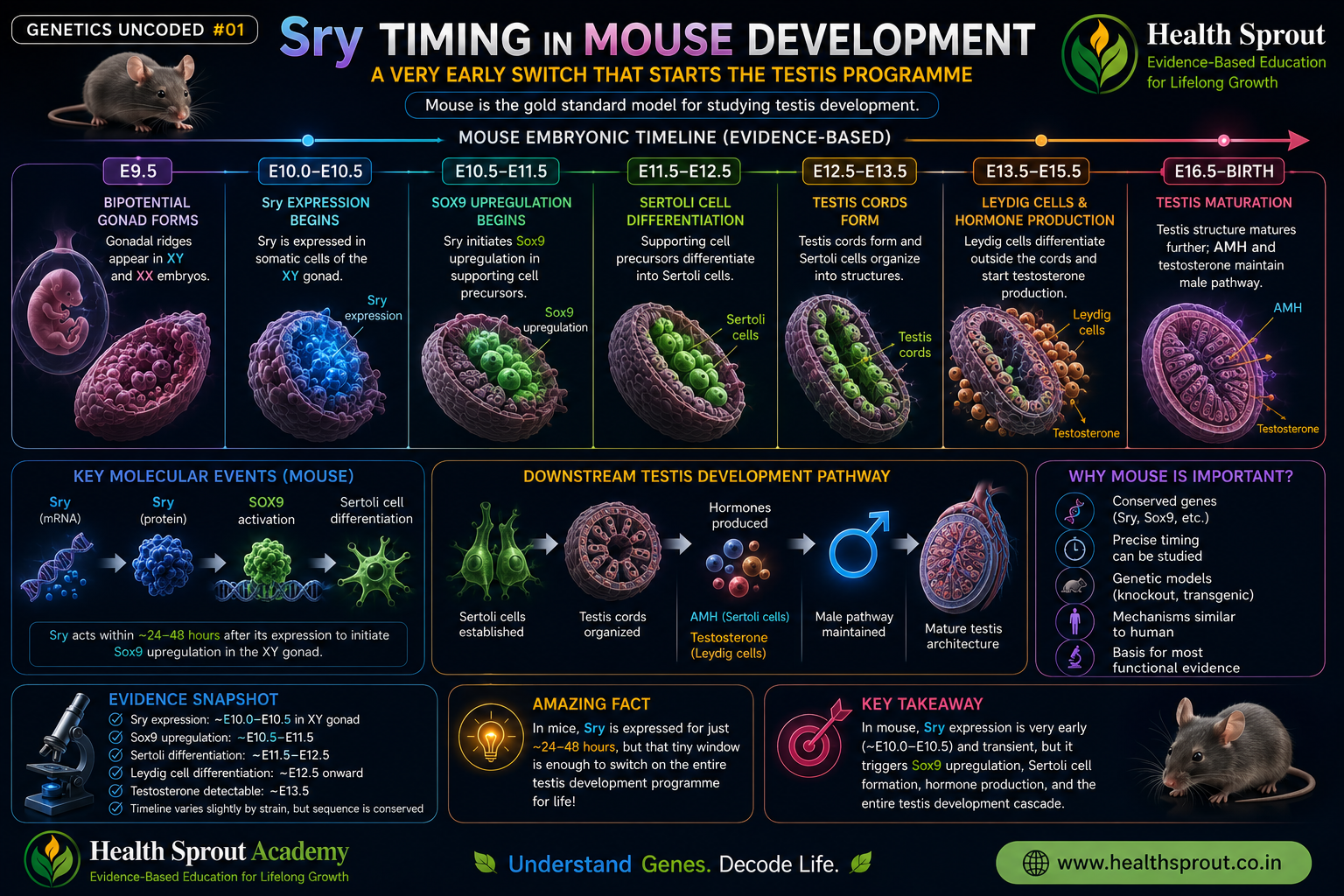
Mouse studies provide precise temporal resolution and show a brief Sry window around testis differentiation. This is model-specific evidence.
What this visual shows
This visual is the human developmental timeline. Read it as a sequence of developmental events rather than as a set of exact universal timestamps: SRY expression occurs during early gonadal differentiation, with SOX9 activity appearing shortly afterward. The key point is the relative developmental order and context. Human developmental timing should not be replaced by mouse embryonic-day labels.
What this visual shows
This visual presents experimental mouse evidence separately from the human timeline. The mouse Sry expression window is shown using mouse embryonic-day terminology because it comes from an experimental animal model. Use this image to understand the timing relationship observed in mice, not to assign those same embryonic-day values to human development.
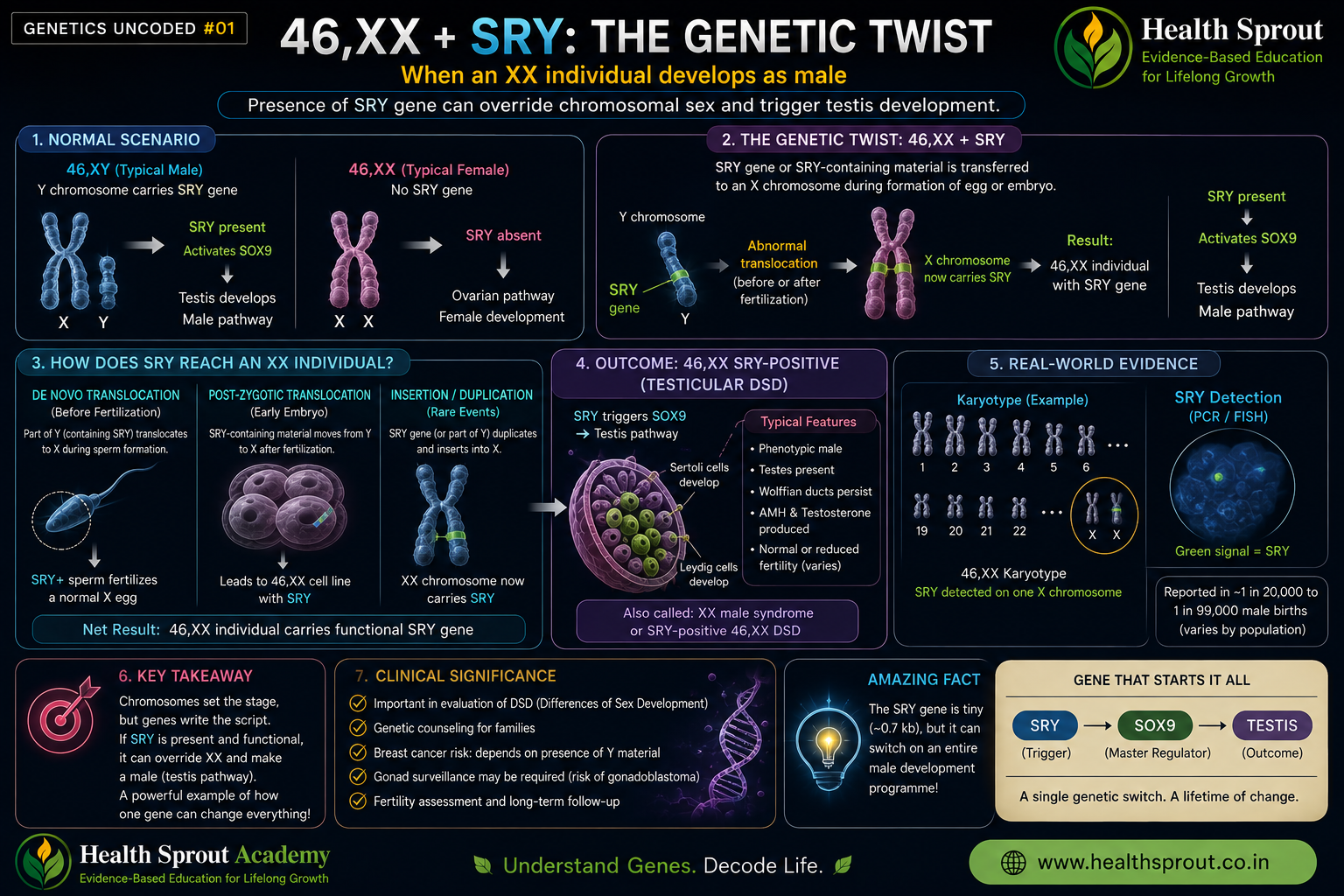
46,XX + SRY: a documented genetic exception
A person can have a 46,XX chromosome complement and still carry SRY-containing Y-chromosomal material. In the classic SRY-positive 46,XX testicular DSD mechanism, abnormal X–Y recombination can move SRY onto an X chromosome.
What this visual shows
This visual explains the classic SRY-positive 46,XX mechanism. During abnormal X–Y recombination, Y-chromosomal material containing SRY can become attached to an X chromosome. The result can be a 46,XX chromosome complement that nevertheless contains SRY, illustrating why chromosome complement and the presence of specific Y-derived genetic material are not always identical.
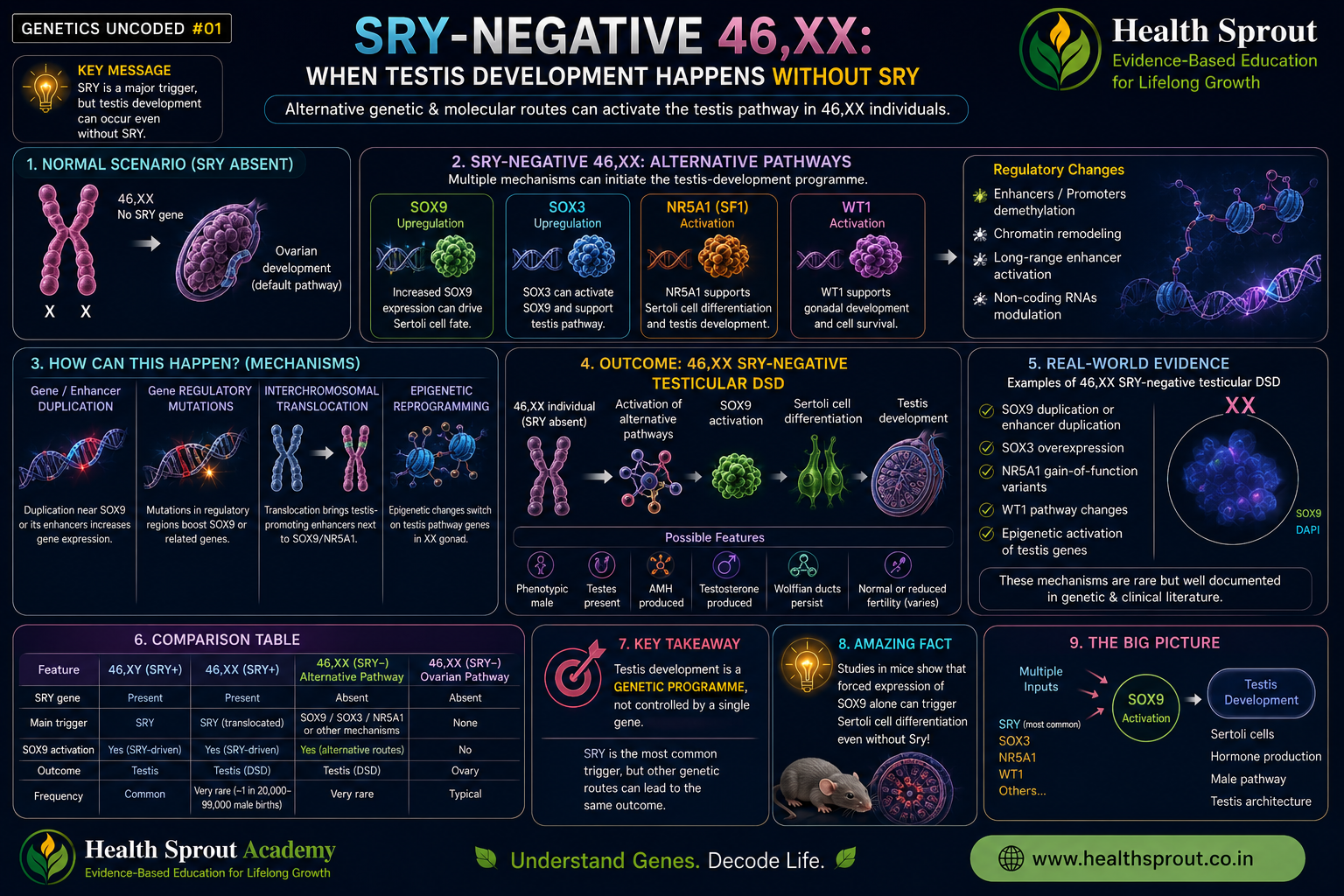
SRY-negative 46,XX testicular DSD
Some 46,XX individuals with testicular DSD are SRY-negative. Established alternative mechanisms include changes involving SOX3 or SOX9 regulatory regions and specific variants in NR5A1 or WT1. This is strong evidence that gonadal development is a network.
What this visual shows
This visual shows why SRY is not the only possible route into the testis-development programme. It highlights established alternative mechanisms associated with SRY-negative 46,XX testicular DSD, including changes involving SOX3 or SOX9 regulatory regions and variants in genes such as NR5A1 or WT1. The key lesson is that the developmental network can be altered through more than one molecular route.
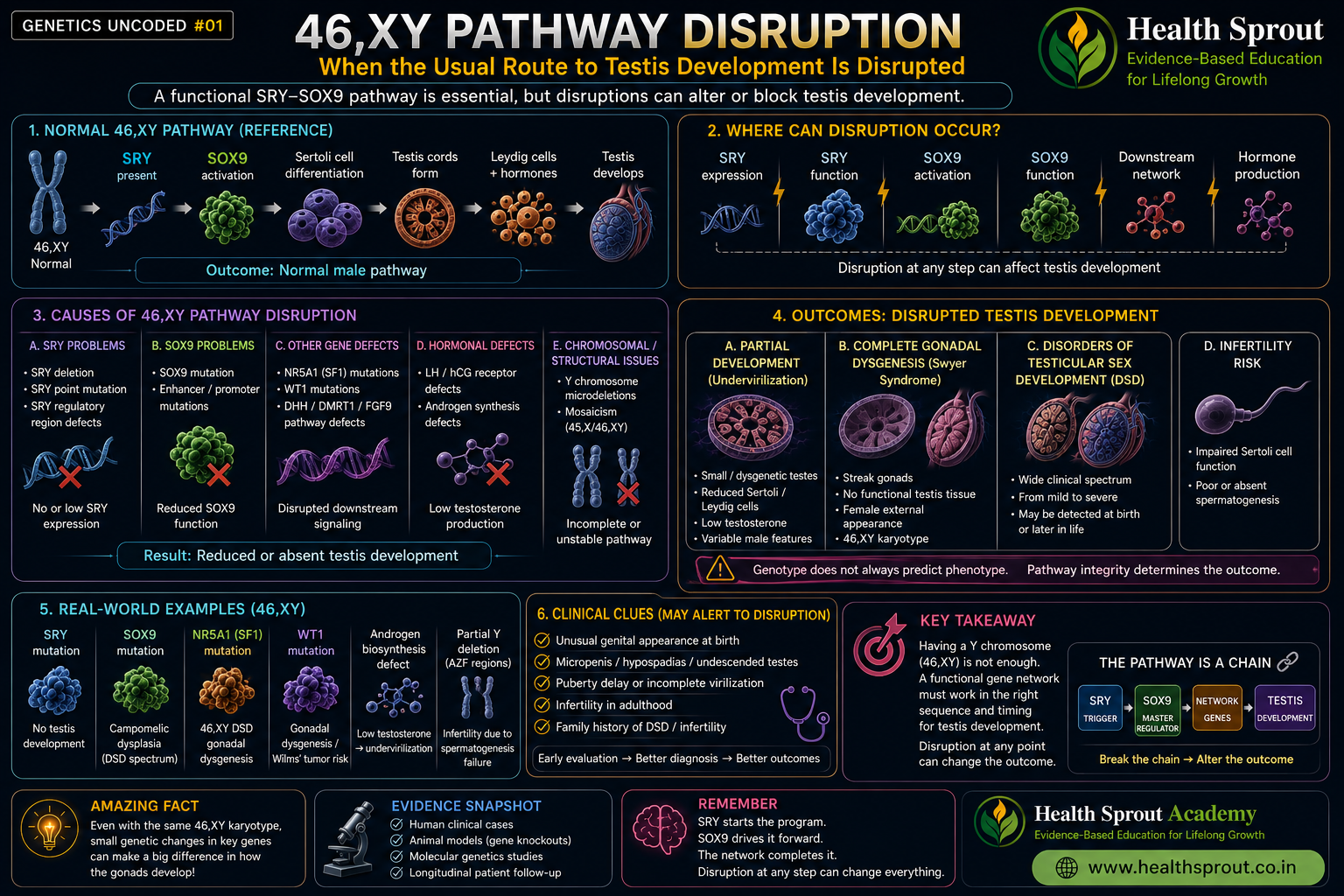
What if SRY is altered in a 46,XY developmental context?
Pathogenic SRY variants can be associated with 46,XY complete gonadal dysgenesis. SRY is one component of a broader developmental system; other genes and regulatory regions can produce related outcomes.
What this visual shows
This visual follows a 46,XY developmental context in which SRY is disrupted. Because SRY is an important trigger for the testis-development pathway, pathogenic SRY variants can interfere with that developmental programme and are associated with 46,XY complete gonadal dysgenesis. The diagram should be read as one pathway-disruption example within a larger genetic and regulatory system.
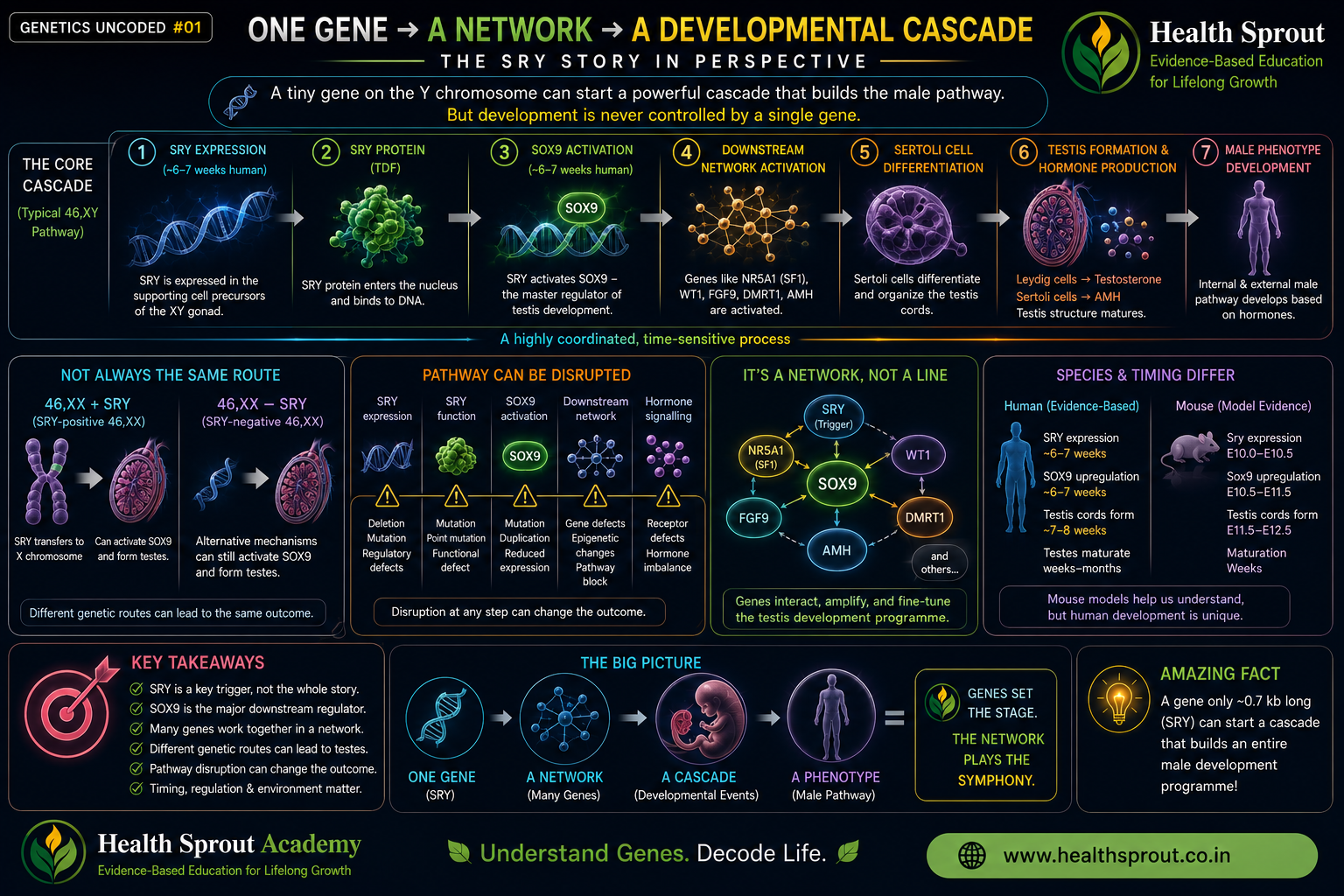
One gene → a network → a developmental cascade
The deeper lesson from SRY is not simply that “one gene controls sex.” Developmental biology depends on networks: transcription factors, enhancers, signalling pathways, timing, cellular context and feedback. SRY is an important trigger and SOX9 is a major downstream regulator—but neither is the entire story.
What this visual shows
This final visual brings the entire article together. Start with SRY as an important early trigger, then follow the expanding network of downstream genes, regulatory elements, signalling pathways, developmental timing and cellular context. The image is designed to reinforce the main lesson: SRY is a key component of gonadal development, but the biological outcome emerges from an interacting developmental network rather than from one gene acting alone.
What SRY does — and does not — mean
Supported
- SRY is on the Y chromosome.
- SRY encodes a transcription factor.
- SRY helps activate/upregulate SOX9.
- 46,XX + SRY can occur.
- 46,XX testicular DSD can occur without SRY.
Too simplistic / not supported
- “SRY is the male gene.”
- “SRY alone determines all aspects of sex development.”
- “SRY determines gender identity.”
- Using mouse embryonic-day timing as a human timeline.
SRY is not the whole story. It is the beginning of a story.
SRY is a key trigger within a larger developmental network. The central simplified pathway is SRY → SOX9, but testis development also depends on other genes, regulatory elements, signalling pathways, timing and cellular context. The same framework helps explain why SRY-positive and SRY-negative developmental exceptions can occur.
Frequently Asked Questions
Is SRY the “male gene”?
No. SRY is a Y-chromosomal protein-coding gene that encodes a DNA-binding transcription factor and acts as a key trigger in the testis-development pathway. Human gonadal development is a multi-gene regulatory network.
What is the most important downstream relationship of SRY?
The simplified central relationship is SRY → SOX9. SRY helps initiate increased SOX9 activity, and SOX9 becomes a major regulator of the testis-development programme, including Sertoli-cell differentiation.
Can a 46,XX individual carry SRY?
Yes. SRY-positive 46,XX testicular DSD is a documented genetic exception, commonly involving translocation of SRY-containing Y-chromosomal material.
Can testicular development occur in 46,XX without SRY?
Yes. SRY-negative 46,XX testicular DSD exists through alternative mechanisms involving pathways and genes such as SOX3, SOX9, NR5A1 and WT1.
Does mouse Sry timing directly tell us the human SRY timeline?
No. Mouse embryonic-day data are experimental model evidence and must be kept separate from human developmental timing.
Does SRY alone determine every aspect of human sex development?
No. SRY is an important trigger within a larger network involving transcription factors, enhancers, signalling pathways, timing, cellular context and feedback.
Why This Matters
The SRY pathway illustrates how a genetic trigger can initiate a wider developmental programme. SRY acts through gene regulation that promotes a testis-development pathway, including downstream regulation involving SOX9, rather than functioning as a single-gene “switch” that controls every aspect by itself.
Myth Bust
Myth: The SRY gene alone determines every feature of biological sex.
Fact: SRY is an important trigger in the typical testis-development pathway, but developmental outcomes depend on multiple genes, signalling pathways, chromosomes and tissue responses.
Practical Application
Study the pathway as a sequence: chromosome context → SRY expression → downstream gene regulation → tissue differentiation. This is more accurate than memorising SRY as an isolated yes/no switch.
Quick Takeaways
- SRY encodes a transcription factor involved in testis development.
- The early gonad is bipotential before pathway commitment.
- Downstream genes and signalling networks are essential to developmental progression.
Scientific Foundation
- NCBI Gene — SRY, Gene ID 6736
- UniProt — Human SRY protein Q05066
- GeneReviews — Nonsyndromic 46,XX Testicular Disorders/Differences of Sex Development
- GeneReviews — Molecular Genetic Testing Table
- NCBI Endotext — 46,XY Differences of Sexual Development
- PubMed — Sry and SoxE genes: How they participate in mammalian sex determination and gonadal development?
- PubMed — Sex determination and gonadal development in mammals