
The Quick Sprout
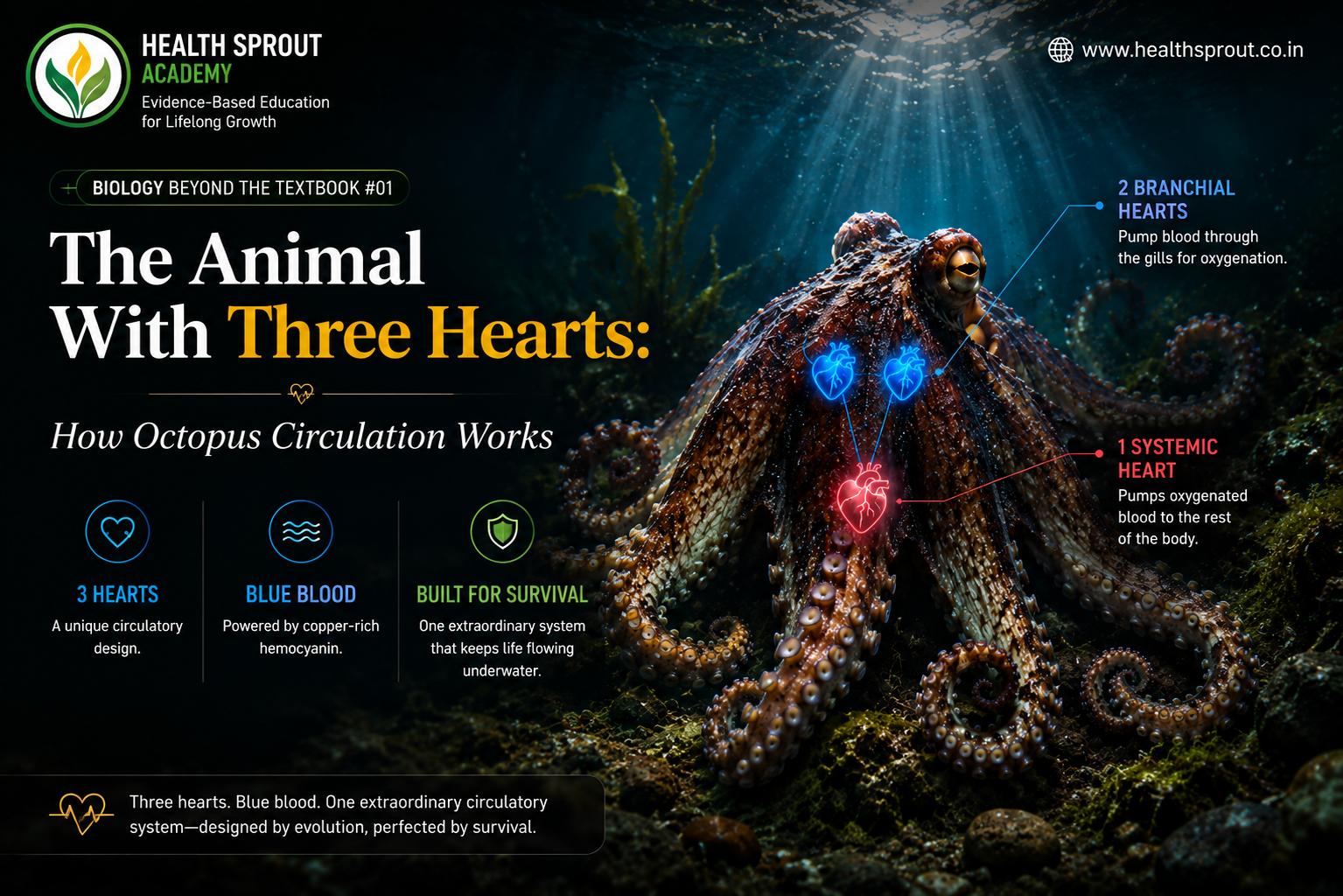
- An octopus has three hearts: two branchial hearts that support blood flow through the gills and one systemic heart that pumps oxygenated blood around the body.
- These are specialised pumps with different jobs working together in a closed circulatory system.
- The interesting biology is the coordination of the three hearts—not simply the fact that there are three of them.
How to use this: Read this box first for the core message, then continue into the full evidence-based explanation below.
The Animal With Three Hearts
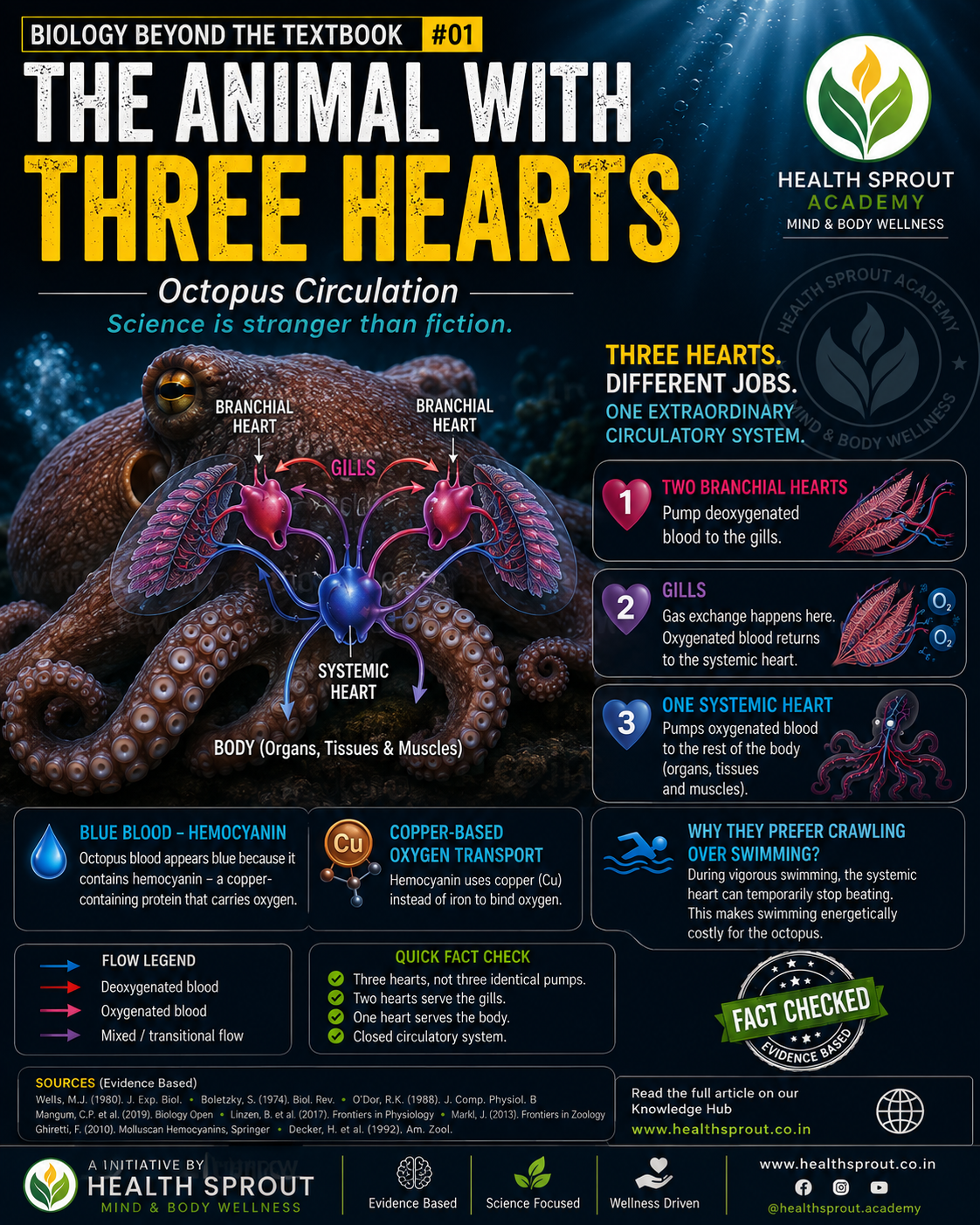
An octopus does not have one heart. It has three. Two are branchial hearts , which support circulation through the gills, and one is the systemic heart , which pumps oxygenated blood around the body. Together they form a specialised closed circulatory system found in cephalopods.
The important idea is not “three identical hearts.” Each pump has a different job, creating one coordinated circulatory circuit.
Two Hearts for the Gills, One for the Body
The two branchial hearts pump blood through the gills. The gills are the respiratory organs where oxygen enters the blood and carbon dioxide is removed. Once oxygenated, the blood moves into the systemic heart.
The systemic heart then pumps that oxygen-rich blood through the systemic circulation to the rest of the body. So the three hearts are parts of one coordinated system—not three separate pumps doing the same thing.
oxygen-poor blood returns
pump through gills
gas exchange + oxygenation
oxygenated blood
main body pump
organs, tissues, muscles
Why Is Octopus Blood Blue?
Octopus blood is blue because its main respiratory pigment is hemocyanin rather than the haemoglobin used by vertebrates. Hemocyanin is a copper-containing oxygen-transport protein. When oxygen binds to its copper centres, the oxygenated protein appears blue.
Copper-Based Oxygen Transport
“Blue blood” is a useful biological clue. It does not mean that octopus blood simply carries more oxygen than human blood; respiratory pigments and circulatory systems have different properties and operate in different physiological environments.
The Really Strange Part: What Happens When It Swims?
Octopus swimming uses jet propulsion : water is expelled through the mantle cavity to create thrust. Vigorous mantle movements are closely linked to respiratory and cardiovascular physiology.
Classic physiological work described a temporary interruption of the systemic heart during vigorous swimming or jet-propelled movement, while the branchial hearts continue to support blood flow through the gills.
Why Does an Octopus Have Such a Complex Circulatory System?
Cephalopods are active marine animals with comparatively high metabolic demands. Their gills must move large amounts of blood for gas exchange, while oxygenated blood also has to be delivered efficiently to active tissues.
The three-heart architecture separates the gill-pumping stage from the systemic circulation. It is therefore more accurate to think of the system as a coordinated pump-and-gill circuit than as “three independent hearts.”
Does Having Three Hearts Make the Octopus Special?
Yes—but the interesting part is not simply the number three. The biological surprise is the specialised division of labour among the hearts, the copper-based respiratory pigment, and the unusual cardiovascular response to vigorous locomotion.
This is exactly the kind of biology that belongs beyond the textbook: a familiar organ system—circulation—can be built in a radically different way in another animal.
What the Science Does Not Say
Do not use these oversimplifications:
- “The octopus needs three hearts because it is highly intelligent.”
- “Two hearts stop when it swims.”
- “The heart stops because the octopus is running out of oxygen.”
- “Blue blood means the octopus has more oxygen than humans.”
- “The octopus is the only animal with three hearts.”
The evidence dossier explicitly recommends more precise wording, especially for the swimming-heart claim and the “only animal” claim.
Frequently Asked Questions
Do octopuses really have three hearts?
Yes. The source material identifies two branchial hearts and one systemic heart.
Are the three hearts identical?
No. They have different roles within the coordinated branchial and systemic circulation.
Why is octopus blood blue?
Because octopus hemolymph uses hemocyanin, a copper-containing oxygen-transport protein; oxygenated hemocyanin appears blue.
Do two hearts stop when an octopus swims?
No. The source-approved wording is that the systemic heart can be temporarily interrupted during vigorous swimming/jet propulsion while the branchial hearts continue supporting gill blood flow.
Why This Matters
The octopus circulatory system is adapted to its respiratory and locomotor demands. Its three hearts and copper-based oxygen transport illustrate how anatomy, circulation and metabolism can co-evolve to support a demanding lifestyle.
Myth Bust
Myth: The three hearts all work in exactly the same way.
Fact: Octopuses have two branchial hearts associated with the gills and one systemic heart that pumps oxygenated blood through the body.
Practical Application
Use the octopus as a physiology example: map the route of deoxygenated blood to the gills, oxygenation, and return to the systemic circulation. This makes the role of each heart easier to understand than memorising three names separately.
Quick Takeaways
- Two branchial hearts move blood through the gills.
- The systemic heart circulates oxygenated blood to the body.
- Hemocyanin is the main oxygen-carrying pigment in octopus blood.
References & Further Reading
- Biology Open / PMC — Octopus insularis as a new marine model for evolutionary developmental biology.
- Frontiers in Physiology — Perfused Gills Reveal Fundamental Principles of pH Regulation and Ammonia Homeostasis in Octopus vulgaris .
- PubMed — Molluscan Hemocyanins.
- PubMed — Minireview: Recent progress in hemocyanin research.
- PubMed — Nervous control of the heartbeat in octopus.
- Journal of Experimental Biology — Nervous Control of the Heartbeat in Octopus.
- Frontiers in Marine Science — Evolution of predator avoidance in cephalopods.